services@jtchip.com
In recent years, the revolutionary development of power electronics and converters paved the way for more scope for research in multiphase drives. Preliminary phases like the three-phase drives showed more torque fluctuations than the new five-phase drives by 67 percent. This encouraged researchers to gain more knowledge about six-phase modulation as MPDs have the feature to segregate power across several phases, therefore reducing power rating per phase. Moreover, as new phases are added, the magneto-motive force distribution is improved, reducing torque ripples in the machine's air gap, and increasing the degrees of freedom.
MPDs are primarily used in Electric vehicles and marine applications, for reducing cost and weight by integrating chargers with contemporary machines, moreover, in ships MPDs are used in place of mechanical poles to control machine speed. However, despite having better features in terms of performance, power density, and fault-tolerant capacity, traditional three-phase drives are still dominant in industries. One of the main aspects of studying MPDs is the modeling and power conversion processes like AC-DC-AC which is fed via a convertor that is based upon pulse-width modulation.
Prominent features of Multiphase Drives
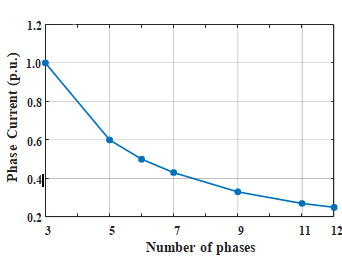
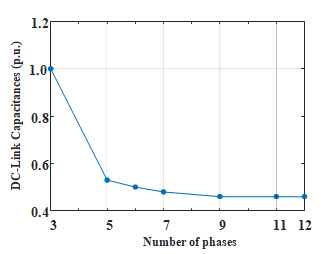
Traditionally used, three-phase drives are not as efficient and cost-effective as Multiphase Drives, mainly due to unique and dominating features like lower power rating per phase, better fault-tolerant operation, and lower DC link current ripples. The highlighting aspect of MPDs is their ability to divide power across a number of phases as shown in Figure 1 which are supplied via converter legs without using parallel components. This property itself tackles issues faced by three-phase drives like poor heat dissipation, different load sharing, and differences in turning on/off timings.